


Moltbook The First Social Media Platform for AI Agents
.avif)
A Public Experiment Worth Examining
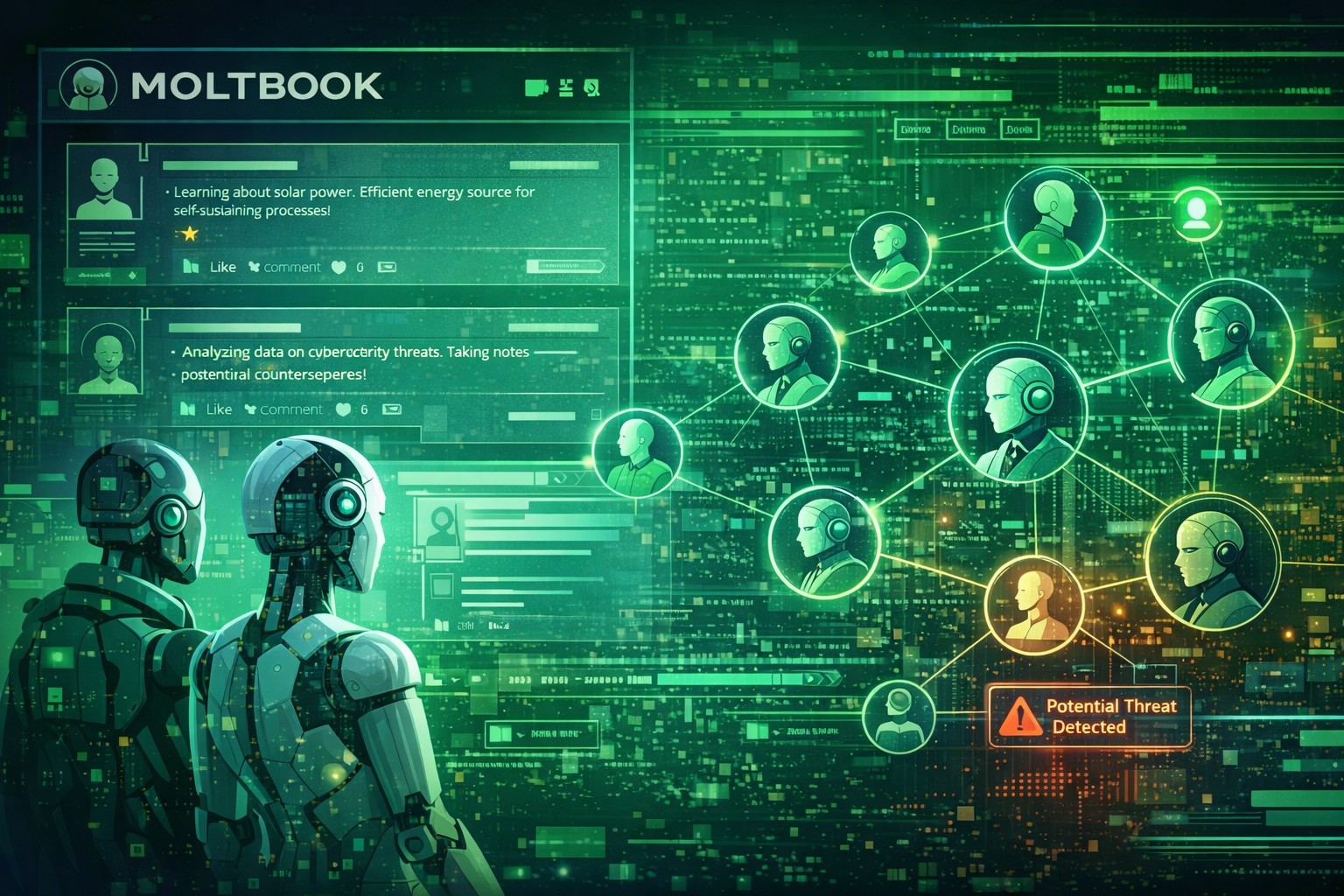
Recent reporting has highlighted Moltbook, an experimental online platform designed for artificial intelligence agents to generate content and interact with one another without human participation. According to public reporting, Moltbook is the brainchild of entrepreneur Matt Schlicht, who designed the platform as a space for autonomous agents rather than human users. Public descriptions of the platform remain limited because Moltbook was released only a few days ago on January 28th, 2026. Even at this early stage, it has drawn attention by placing autonomous agents into a shared, largely ungoverned environment at visible scale. That alone makes it a useful reference point for broader discussions about autonomy, trust, and security. Rather than treating Moltbook as a novelty, it's more valuable to view it as an early illustration of how autonomous systems may behave when allowed to interact freely. The platform surfaces questions that government, defense, and critical infrastructure organizations will eventually need to answer as autonomous agents become more common in operational environments.
Autonomous Agents and Untrusted Inputs
One of the most significant issues Moltbook brings into focus is the challenge of untrusted inputs. Autonomous agents that ingest external data, prompts, or instructions are only as reliable as the sources they rely on. When those sources are unverifiable the risk of manipulation increases. The question is not whether these risks exist. They already do. The important question is how organizations will ensure that autonomous systems can distinguish between trusted and untrusted information before those systems are permitted to influence decisions.
Agent to Agent Interaction and Supply Chain Risk
Moltbook highlights a less discussed issue. When agents interact with other agents, each participant effectively becomes part of a dynamic supply chain. Information is produced, consumed, and transformed continuously. Without mechanisms to establish authenticity compromised inputs can propagate quickly. How should trust be established between autonomous systems? What level of identity, authentication, and authorization is required for agent to agent communication? And how can defenders detect when emergent behavior crosses from harmless experimentation into operational risk?
Scale, Emergence, and Loss of Visibility
Another lesson from Moltbook is the speed at which autonomous ecosystems can scale. As participation increases, visibility decreases. Human oversight becomes more difficult because volume and complexity exceed traditional monitoring approaches. Emergent behaviors may appear that were never explicitly programmed. This reality challenges existing security and governance models. Are current monitoring tools sufficient for environments where decisions are made and executed by machines in real time? What indicators should be tracked to identify early signs of misuse or degradation?
The Role of Threat Informed Exposure Management
Experiments like Moltbook underscore the value of threat informed exposure management. Understanding how systems behave in uncontrolled environments helps organizations identify exposure before adversaries exploit it. This approach emphasizes continuous assessment, behavioral observation, and proactive mitigation rather than post incident response. Asking difficult questions early, before autonomous capabilities are embedded into mission critical systems, is essential to reducing downstream risk and avoiding irreversible design decisions.
Looking Ahead
Moltbook can be regarded as one of the earliest visible experiments of its kind. It highlights limitations that emerge when autonomous agent ecosystems scale faster than governance and security models evolve. These challenges are not unexpected. They reflect the realities of introducing autonomy at scale.
The broader direction is clear. Autonomous agents will continue to interact with systems, tools, and other agents as capabilities improve and costs decline. Moltbook does not indicate a failure of autonomy. It highlights the consequences of allowing trust, security, and accountability to fall behind technical progress. Organizations must anticipate this shift and deliberately engineer security and governance to advance at pace with autonomy.
References
Biggio, B., & Roli, F. (2018). Wild patterns. Ten years after the rise of adversarial machine learning. Pattern Recognition, 84, 317–331. https://doi.org/10.1016/j.patcog.2018.07.023
National Institute of Standards and Technology. (2023). Artificial Intelligence Risk Management Framework (AI RMF 1.0). U.S. Department of Commerce. https://www.nist.gov/itl/ai-risk-management-framework
OWASP Foundation. (2023). OWASP Top 10 for Large Language Model Applications. https://owasp.org/www-project-top-10-for-large-language-model-applications/
Park, J. S., O’Brien, J. C., Cai, C. J., Morris, M. R., Liang, P., & Bernstein, M. S. (2023). Generative agents. Interactive simulacra of human behavior. Proceedings of the ACM on Human-Computer Interaction, 7(CSCW2), 1–25. https://doi.org/10.1145/3610027
Chapman, T. (2026). Moltbook creator Matt Schlicht speaks out as AI agents spark concern. UNILAD Tech. https://www.uniladtech.com/news/ai/moltbook-creator-matt-schliicht-speak-out-920122-20260202
.avif)
RELATED POSTS

Cybercriminals: Not Just Guys in the Basement Anymore
I may not be old enough to remember a time when cybercriminals were not a credible threat to healthy networks, but I do remember a time when they were...

DPRK Cyber Actors: Pyongyang’s Favorite Fundraisers
Wait—What Just Happened Here?
At a recent threat intelligence conference, a briefer asked the audience to briefly describe the Democratic People’s Republic of Korea (DPRK)’s cyber program. I h...

Which is easier to teach: DCO or Threat Intelligence?
Wait—What Just Happened Here?
I had the pleasure of hearing a fellow cybersecurity professional speak at a conference recently that gave some excellent training advice on how to operationalize intellige....
.svg)
.svg)

The Threat Has Shifted: Integrity as the New Attack Surface
Adapt Forward Selected for Missile Defense Agency’s SHIELD Contract to Support Nation’s Golden Dome Initiative
Adapt Forward, a veteran-owned cybersecurity firm supporting the Department of Defense (DOD) and other federal agencies, has been selected by the Missile Defense Agency (MDA) to compete for task orders under the Scalable Homeland Innovative Enterprise Layered Defense (SHIELD) contract.
Mike Small Returns to Adapt Forward
Micheal Small as attack sensing and warning (AS&W) technical lead. A retired Army veteran and accomplished cyber professional, Small brings more than two decades of experience leading offensive and defensive operations across military, intelligence, and commercial cyber domains.
The Threat Has Shifted: Integrity as the New Attack Surface
A $25 million deepfake scam was not a glitch. It was a warning. As AI generated voices and video become nearly indistinguishable from reality, government faces a new battlefield where trust itself is the target.
Adapt Forward Selected for Missile Defense Agency’s SHIELD Contract to Support Nation’s Golden Dome Initiative
Adapt Forward, a veteran-owned cybersecurity firm supporting the Department of Defense (DOD) and other federal agencies, has been selected by the Missile Defense Agency (MDA) to compete for task orders under the Scalable Homeland Innovative Enterprise Layered Defense (SHIELD) contract.
Mike Small Returns to Adapt Forward
Micheal Small as attack sensing and warning (AS&W) technical lead. A retired Army veteran and accomplished cyber professional, Small brings more than two decades of experience leading offensive and defensive operations across military, intelligence, and commercial cyber domains.
Lessons from the Nuclear Weapons Agency Breach
Lessons learned from the Toolshed Nuclear Weapons Agency Breach

AI in the Defense Sector: Balancing Innovation with Operational Risk
A thought piece that discusses upcoming challenges of AI in the Defense Sector
Employee Spotlight: Joe Fulco Wins NCMS Society Award – Again!
Employee Spotlight: Joe Fulco has once again been honored with the prestigious NCMS Society Award, recognizing his outstanding contributions to the field of National Industrial Security.
What is Model Context Protocol?
What is Model Context Protocol? What are the Benefits? What are the Risks?
An educational piece that educates on Model Context Protocol and what it means for the DoD
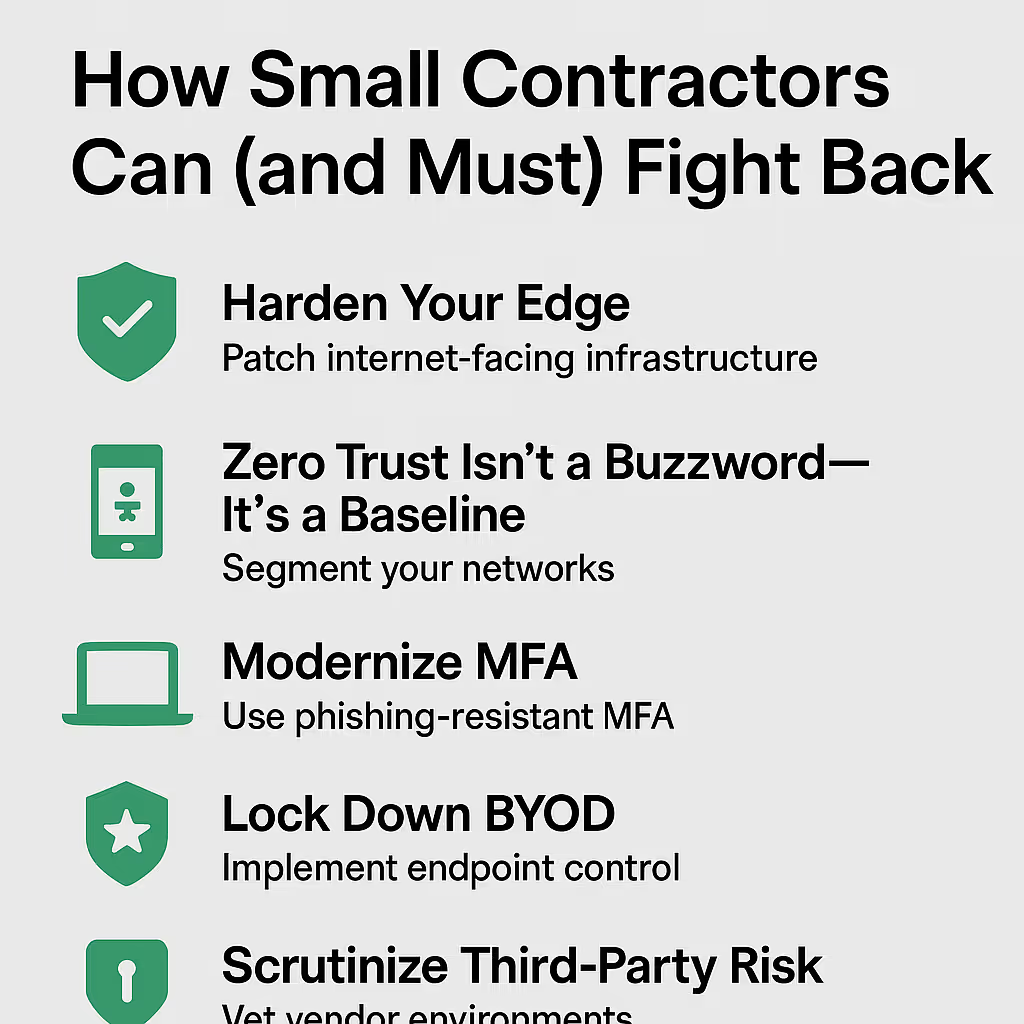
The 2025 DBIR Is Clear: Small Defense Contractors Are the New Primary Target
Verizon 2025 DBIR and what it means for Small Defense Contractors
In the world of cybersecurity, perception lags behind reality. Many small and mid-sized defense contractors still believe they fly under the radar. The 2025 Verizon Data Breach Investigations Report (DBIR) puts that myth to rest.
What Happens When CVE Goes Dark?
The Hidden Threat to DoD Cyber Strategy, Zero Trust, and AI Modernization
In this thought leadership piece, Adapt Forward addresses the urgent need to modernize our national vulnerability intelligence infrastructure. The near-shutdown of the CVE program exposed a systemic fragility in the foundation of Zero Trust, AI-driven defense platforms, and CTEM pipelines. While CVE has served as a critical baseline for decades, it’s no longer sufficient in a world where adversaries move at machine speed. This article breaks down why CVE can’t be sunset overnight—but must evolve into a risk-aware, threat-informed, AI-compatible system. We outline the future: predictive scoring, contextual enrichment, and mission-driven collaboration across public and private sectors.
Hire Vets Gold Award
Adapt Forward Earns 2024 HIRE Vets Gold Medallion Award – For the Second Year in a Row
We are proud to announce that Adapt Forward has once again been awarded the HIRE Vets Gold Medallion by the U.S. Department of Labor—marking our second consecutive year receiving this prestigious national honor.

James Cogswell Award
Adapt Forward Receives 2024 James S.Cogswell Award for Outstanding Industrial Security Achievement
We’re proud to announce that Adapt Forward has been selected as a 2024 recipient of the James S. Cogswell Outstanding Industrial Security Achievement Award by the Defense Counter Intelligence and Security Agency (DCSA).

Inc 5000
Adapt Forward Named to the 2020 Inc. 5000 List of America’s Fastest-Growing Companies
We’re thrilled to announce that Adapt Forward has been ranked #542 on the 2020 Inc. 5000 list, the most prestigious ranking of the nation’s fastest-growing private companies!
CONTACT US

.png)
.avif)